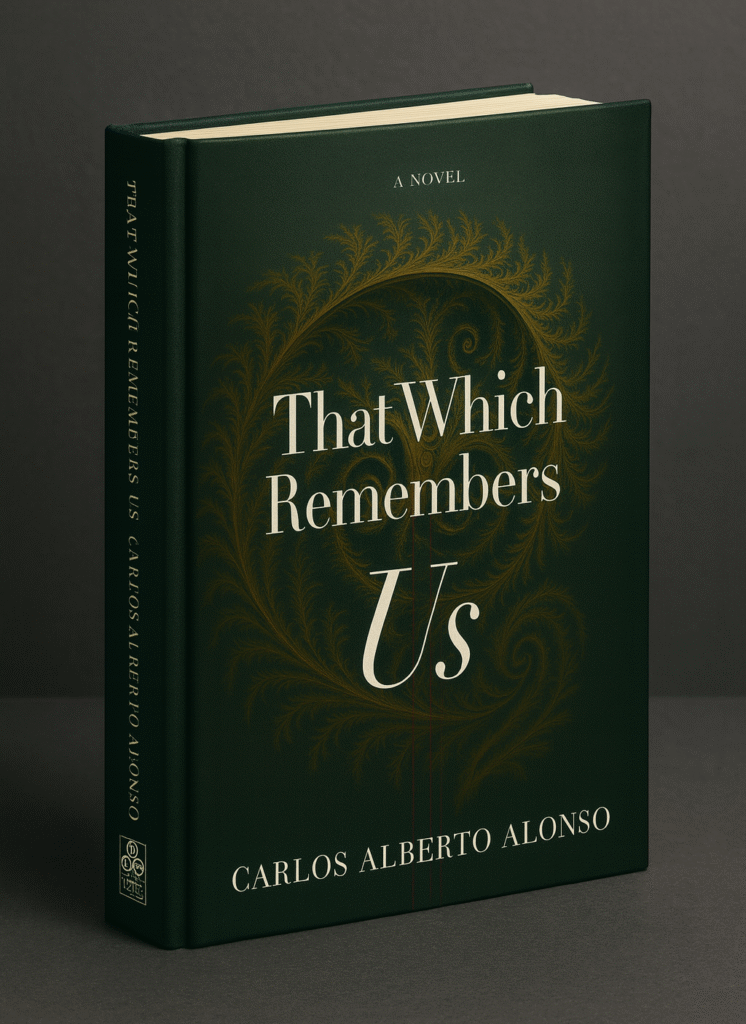
Carlos Alberto Alonso’s That Which Remembers Us is a resonant, genre-defiant debut about inheritance, exile, and the longing to restore what history has silenced.
When Patricia Ferme travels to a forgotten estate in Spain following the disappearance of her grandfather—a reclusive composer—she is not seeking answers so much as continuity. What she finds instead is a manuscript encoded with grief, and the echoes of a symphony that refuses to be finished. As she uncovers the deep roots of her family through ancestral rituals, scientific transgressions, and the endangered landscapes of mountainous Asturias, she is drawn into a quiet but urgent reckoning: with the ethics of memory, the shadow of antagonists, and the cost of preserving what we love.
Spanning a Neolithic past, a disfigured present, and a fragile future, That Which Remembers Us is both speculative and philosophical—a novel of ideas grounded in flesh, place, and song. With its lyrical cadence and spiritual curiosity, Alonso’s work joins a lineage that asks not only how we remember—but who gets to decide what is worth remembering at all.
Excerpt
The Man in the Lecture Hall
Patricia hadn’t expected the road to feel so strange. The narrow lane pulling away from the village of Langrave gave way to long, quiet stretches of land that seemed to have held its shape for generations. Sloping fields rising and falling like thought. Here and there, a farmhouse hunched into the hillside, a road sign barely legible with rust. She drove with the windows open just enough to let the air in—crisp, moist, leaf-sweet. The silence inside the rented Fiat carried its own weight. Lucas’s journal and manuscript sat in her satchel, angled on the passenger seat. Their presence immediate, yet silent.
The rain began like a suggestion. A soft tapping on the glass, almost shy. Memories trying to make themselves known. Looking through the windshield, she watched as the droplets found each other and veered sideways with the curve of the mountain. The wipers traced their arc again and again, steady, indifferent. She adjusted her grip on the wheel. Noticed the way her breath caught—just slightly, but enough. She drove with the window cracked, Lucas’s notebooks touching her thigh, and set herself a simple task: find the person who had listened to him hardest.
It was always the rain that brought it back. Not asked for. But certain. A whisper, not quite sound yet, threading into something with shape, with weight. She recognised this stretch. The bend in the road. The slope, the sharp stones pushing out from the earth like old bone. She knew this place. And yet was certain she’d never driven it before.
Her eyes moved to the rearview mirror. Some part of her expected light—headlamps appearing around the bend. But the road was deserted. Pale and threadbare, unspooling into the fog. She pressed down a little harder on the accelerator, felt the electric engine respond beneath her, the thrum of it travelling through her palms.
The rain had thickened—striking the roof in clusters. She turned the dial on the dash: only static. She shut it off. She wanted quiet. She wanted the weather—its rhythm, its memory. She rolled the window down a notch and the wind reached in, easy as an old friend. Outside, water poured off the granite outcrops, ran in sheets down the stone banks, collected in the dips along the gravel shoulder. She swallowed. These mountain roads—how they coiled, how they hid—still lived in her body.
The rain softened as she entered the tunnel, its edges vanishing into the dark like sound into cloth. One of many that cut through these mountains—shortening distances the land had once insisted upon. Patricia slowed down, instinctively cautious. Hands steady at ten and two. Knuckles pale with pressure. She glanced at the passenger seat. Lucas’s notebook had slipped halfway from her satchel. Brittle spine, corners torn. Memory made material. Vala—whoever you were to him. She looked too long. The car slid—barely. But enough.
Her chest caught. She inhaled, held, exhaled. Righted herself.
And then the memory came. Just like that. Suddenly she was back. Langrave. A child. The terrace drawn out like a held breath. Rain and cedar smoke hanging in the damp. Lucas used to call it his Synthesis Cathedral. The studio that clung to the old house like an annex of weather—half-glass, half-stone, its arched windows staring into the jagged Cantabrian spine. On rainy days, he’d fling open the doors and let the sound loose, his fingers coaxing tones from circuits and waveforms, as if summoning sounds that seemed older than music. Patricia would sit cross-legged on the warm slate floor, knees pulled close, watching.
To her, it was the sky that was playing. Every drop tuned. Every gust woven in. The sounds spilled into the trees, ran over rooftops, braided into the downpour. Lucas played like a man in dialogue with the storm—hands moving across keys and knobs and sliders, reading the weather as score.
This was her church. Rain, resonance, and the kind of silence you can only reach through sound. She never saw him more alive than there—eyes closed, brow furrowed, body moving just enough to let the music pass through. Sometimes she’d lie flat on the stone, eyes shut, feeling the pulse come up from the floor. She too was part of it. The music. The rain. The strange world Lucas could pull from the air.
The last time she’d seen him play like that, James, Nuria, and her—her parents—had been visiting for his birthday. She remembered the smell of sweetness and alcohol on her grandfather’s breath. The way his laughter fractured against the walls. She remembered Nuria’s smile tightening, just slightly, each time the men grew louder. Her father, leaned against the terrace railing, electric guitar slung across his chest, cigarette trailing smoke in the rain. Laughing. Drinking. Half-playing along with Lucas in a kind of drunk, syncopated joy that made the whole room tremble.
The bottles had emptied before sunset. Lucas clapped James on the back.
“Go on. Just to the village. Another bottle. Maybe bread. You’ll be fine. Go now before they close.”
She remembered her father hesitating. The way he looked at the road from the terrace, the rain. The slight, quiet pause. But Lucas waved him off, already reaching for the next patch cable to conjure a new sound. James took the keys, smiled from the doorway, saluted her like it was a game. Then walked out into the downpour.
He didn’t return.
Nuria had been in the city that day. She came home to sirens and silence.
They found James still strapped in the car, crumpled in the riverbed. The fall had broken the undercarriage. The current had done the rest. His lungs were full of water by the time they reached him. Lucas never played music again, after that day. The Cathedral closed its mouth. Dust filmed the glass, pooled in corners. Nuria never set foot in Langrave again. Weeks later, she left with Patricia. No explanations. No return.
But Patricia did. More than once. As a young girl, something always pulled. Something she couldn’t name, but couldn’t leave behind either. The house was changed. So was her grandfather. Ghosts of themselves. She moved on, as people do. Studied art at OCAD in Toronto, where the rain lacked the same shape—carried other memories. Lovers passed through like brushstrokes—perfume and unfinished sketches. She married Colin. A lawyer. Kind. Predictable. Everything Lucas wasn’t. Their life was calm. Clean. Colin didn’t ask about her ghosts. Patricia never felt the need to share them.
Nuria said nothing more of her father. Carried her grief like a stone tucked deep inside. Patricia stopped asking. But the terrace stones still held the rain’s melody. And the Cathedral waited. With its dust. Its silence thick in the corners, as if the sound had never left—only curled inward, waiting.
Patricia blinked, hard. Her hands were locked on the wheel, rigid without her noticing. The present surged back all at once.
A horn split the silence.
Her eyes snapped forward as she exited the tunnel. Rain, road, cold. A delivery van came fast around the curve, headlights cutting through the grey. She jerked the wheel on instinct. The tires lost grip. The car slid sideways, fishtailing across the slick asphalt. She screamed as the back end kicked out—then snapped back into place, just as the van shot past, brake lights stuttering into the mist.
Her heart, louder than the rain. She skidded into the shoulder, gravel rising in a hiss beneath her. The car thudded to a halt. Rain hammered the roof. Hammered her pulse.
The wipers dragged across the glass—harsh, relentless. She sat there, gasping. Breath short. Staggered. Her knuckles had gone bone-white. The rain struck like needles. Steel. Memory. She closed her eyes. Her father’s car. The river. And for a moment, her fate felt too close to his.
As she drove on, the rain led into a thick fog. Steam rose off the road, twisting beneath the car. A pocket of water splashed beneath her as she cut a corner around the bend, throwing a fan of muddy spray up the side window.
Inside, the air felt too warm now. Claustrophobic. She rolled the windows down completely. A rush of sharp rain and mineral air swept in—wet slate and ozone.
Her foot found the brake. The car eased into the next bend now, into the coastal valley. The road stretched ahead like a ribbon cut from silver fabric—glistening. The city was still twenty minutes away. But now she was awake. And the rain was different. Gentler.
She exhaled, shaking off the residue—like the aftertaste of a bitter drink. The radio was still off. Only the sound of tires moving through water and the reverberation of her flashback. In that tunnel it had felt like she was driving through something denser than air, as if she might hold her breath through it, and at any moment gasp.
The road opened after the last bend. Flattened out. The city began to appear slowly, cautious. First came the industrial edge—concrete, rust, quiet refusal. Then the older quarters: stone buildings weathered to the colour of old bone, facades dark with damp, rooftops patched by centuries.
Above it all, the towers of San Salvador pierced the fog—not triumphant, just present. The rain had thinned into silver drizzle, ticking gently on the roof. Oviedo was beautiful. But it carried weight. History pressed into its stones, memory into its hills. It welcomed you without demand—quietly, without ceremony. Recognising something in you before you knew it yourself.
She passed narrow alleyways on the left—some still cobbled, catching the light like fish scales—and higher up, the decaying balconies and ironwork spoke of lives once elaborate, now folded into quieter rhythms. In the oldest parishes, the Camino Primitivo still wound its way toward the cathedral square, just as it had for more than a thousand years. Pilgrims and ghosts walking side by side.
She parked on the far side of the Campo de San Francisco, where the city quiets just enough to hear its age. The path through the park was clean, cultivated, held with care. Even so, it breathed with something older.
Near the centre, a great oak tree leaned heavily across the walkway—its limbs gnarled with time, its bent trunk held up by a stone brace built right out from the middle of the cobbled path. A quiet monument to resilience. To reverence. She slowed as she passed it. Touched the stone.
She sat for a while on a bench, watching the park shift around her. Young couples passed, and single mothers with strollers. Some at peace. Some taut at the shoulders, feet parting puddles that shimmered like bruises on stone. The world moved like it was behind glass.
Patricia let the memory of her father slip back, deeper into its cage. It hadn’t come that clearly in years. Then her breath caught—fast, shallow. She counted, as she’d learned to do. One… two… three… letting the rhythm ease her back into the moment. A small ritual. Not to erase the anxiety—it never left—but to dull its edge. To make space.
She exhaled slowly, imagining the breath leaving her fingers, her spine, the back of her eyes. Eventually, the trembling stopped. Not because she was calm, but because she remembered how to appear that way. And most days, that was the best she could manage.
Standing up, she pulled her coat tight and walked toward the entrance of the University of Oviedo. If Lucas left a trail, it likely began here.